How to anticipate the length of joint movement?
Anticipating joint movement is essential for proper joint design and ensuring that sealants and materials used in construction can accommodate the movement without failing.
Methods to Anticipate Joint Movement Caused by Temperature Changes
- Thermal Expansion Calculations
- Coefficient of Thermal Expansion: Determine the coefficient of thermal expansion for the materials used.
- Temperature Range: Calculate the movement based on the expected temperature range.
- Formula: For linear expansion, use the formula:
ΔL=L×α×ΔT
Where:
- ΔL = Change in length of element (e.g. concrete slab)
- L = Original length
- α = Coefficient of thermal expansion (concrete = 12 x 10-6)
- ΔT = Change in temperature
Example Calculation for Thermal Movement
Assuming there are 2 pieces of concrete slabs like below cast during the summer when temperature was +40°C, and a joint with 30mm width was formed. We need to determine how much the joint would move when temperature drops to the lowest in winter, say -10°C.
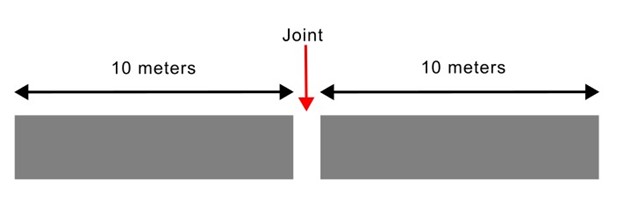
Therefore, by calculating using the equation ΔL=L×α×ΔT, when temperature change is 50°C,
Movement of each piece of concrete slab
= 10m x 12 x 10-6 x 50°C
= 10 x 0.000012 x 50
= 0.006m
= 6mm
Movements of both concrete slabs
= 6mm x 2
= 12mm
Therefore, the joint width when temperature drops to -10°C, will become 30mm – 12mm = 18mm. A joint width reduction of 12mm indicates a -40% change (12mm / 30mm = 0.4).
A sealant with a ±50% Movement Capability / MAF must be chosen to seal this joint.
CTE of Common Construction Substrates:
Coefficient of linear thermal expansion α | |
Material | α in 10-6/K at 20 °C |
23 | |
17.3 | |
12 | |
11.1 | |
10.8 | |
8.5 | |
Summary
Anticipating joint movement would help decide joint width and type of sealant used in sealing the joint. Ignoring these concerns could cause failures in the joint.