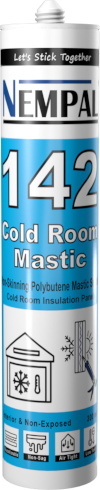
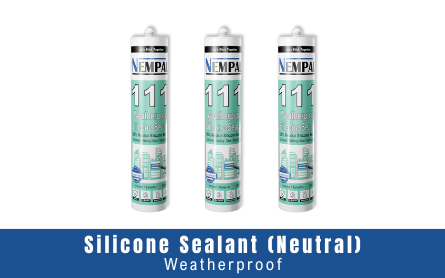
A permanently soft, non-skinning, polybutene-based mastic formulated for use in cold room construction, refrigerated container components and other types of insulation panels. It is primarily used to seal butt joints between adjacent panels in thermally insulated structures, preventing hot/cold air transfer through gaps and thereby reducing energy consumption.
Its polybutene-based composition ensures excellent resistance to water vapour transmission and excellent adhesion to diverse substrates without hardening. It is suitable for applications requiring a non-skinning, durable and permanently plastic mastic. It adheres well to insulation panels made of PU (Polyurethane) foam, PIR (Polyisocyanurate), and EPS (Expanded Polystyrene), and also other substrates like metals, glass, timber, masonry, and many types of plastics.
The permanently non-skinning plastic nature enables it to reseal even if the bond is broken, ensuring a reliable airtight seal. This unique property makes it ideal for cold room installations where panels may require disassembly and reassembly during maintenance, reconfiguration, or relocation.
Features & Benefits
Resist water vapour transmission
Non-skinning – does not cure or harden
Non-Sagging – OK for vertical applications
Excellent low temperature properties
Won’t separate or bleed
Moisture resistant – ideal for humid environments
Soft & Pliable
Odourless
Non-tainting
Non-corrosive
Low shrinkage (<5%)
Excellent adhesion to many substrates
Appearance Colour Density Slump Shrinkage Service Temperature Application Temperature
: : : : : : :
Non-Sagging Soft Paste Off White 1.5 –1.6 g/mL < 2.5 mm < 5% -40°C to +80°C +5°C to +35°C
Typical sealing applications include:
Cold room insulation panels
Refrigeration unit construction
Concealed butt joints
* Users are responsible to carry out test prior to installation to confirm compatibility with actual substrates, work conditions, and service requirements.
Remove all residual dirt, grease, oil, frost, water, and old mastic/sealant thoroughly. Clean the surface with a piece of white cloth with solvent, then wipe immediately with another piece of clean cloth. Do not use soap or detergent.
Prepare the cartridge: cut the seal at the top of the cartridge. Screw on the nozzle and trim it to the desired bead size.
Apply the mastic: hold the applicator gun at a 45-degree angle. Slowly push forward while squeezing the trigger to dispense the mastic evenly onto the butt surface of one of the two panels. A bead of minimum 5mm is recommended to ensure that the mastic maintains contact with adjacent panel surfaces and remains functional in preventing passage of air, in case there is slight movement in the insulation panels.
Assemble surfaces: after applying mastic, join the surfaces together and assemble.
Substrate compatibility: for new or untested substrates, always conduct a pretest to confirm suitability before full application.
Each cartridge will cover approximately 15 lineal meters with a 5 mm bead.
Store properly in a dry and well-ventilated place with temperature between +5°C to +30°C.
Use within 36 months from date of production.
Cartridge – 300 ml (24 cartridges / carton)
Always test before use – user is responsible to test before using to confirm the mastic produces desirable results.
It is NOT recommended for the following applications:
Exposed joints where the mastic can be subject to hand contact, dirt pick-up, or be tampered with due to non-skinning nature.
Non-elastomeric – not suitable where dynamic joint movement or stress is expected (e.g., truck bodies, caravans).
Weather-exposed or underwater applications.
Applications where surface should be painted – mastic is a non-drying paste hence not paintable.