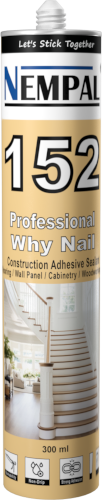
Fast-Cure Solvent-Based Construction Adhesive Sealant
A solvent-based construction adhesive sealant formulated with synthetic rubber for professional use. It is suitable for a wide range of bonding applications in flooring, construction, renovation, woodworking, furniture manufacturing, and DIY work.
The product offers rapid curing, developing high bond strength within a short time and enabling workers to handle and position bonded components without prolonged waiting. Its rheology is engineered for excellent non-sag application, even when applied in blobs, allowing effective bonding of flat materials – such as floorboards – onto uneven surfaces.
NEMPAL® 152 does not cure into an overly rigid, rock-hard state, which makes on-site removal for repair or replacement considerably easier. After curing, it retains a slight elastomeric character that accommodates dimensional movement, such as the natural expansion and contraction of floorboards during service.
Features & Benefits
Non-Sag – Gap-Bridging
Fast Curing
Fast Grab – Efficient Workflow
Natural Wood-Like Color
High Wetting Characteristic – Effective Surface Penetration
Balanced Rigidity – Easier Rectification
Strong Shear Performance – Reliable Bonding
Works On Various Common Substrates
Slightly Elastic – Allowing Movement Of Bonded Object
Free Of Harmful Methylene Chloride
Easy To Apply – Even At Low Temperature
Stops Flowing When Stop Pressing
Curing System
:
Solvent evaporation
Base Material
:
Synthetic rubber
Appearance
:
Thixotropic thick paste
Colour
:
Light Brown
Odor
:
Light solvent smell
Specific Gravity, g/mL
:
1.1 – 1.2
Solid content, %
:
~75
Lap shear strength, N/mm²
(ASTM D1002 – wood to wood)
:
2.9
Working Time, minutes
(at 25 °C & 50% R.H.)
:
5 – 10 *
Curing Time, hours
:
24 – 48 *
Application Temperature
:
-20 °C – 38 °C
Service Temperature
:
-20 °C – 60 °C
* Varies depending on temperature, humidity, substrate porosity, thickness of adhesives applied, and application methods.
Compatible with most construction materials: wood, plywood, corkboard, MDF, gypsum board, FRC board, certain plastics, metal substrates like aluminium and GI Steel, concrete, masonry, glass, ceramics, tiles, bricks, stones, veneer, etc.
Typical applications include:
Flooring
Floor panels to stair / subfloor / batten
Floor skirting boards
Floor stair treads, risers, nosing
Floor edging, transition profiles, reducer, end cap
Interior Decorations
Wainscoting
Cornice & Coving
Architraves & trims
Decorative Wall Panels
PVC/ WPC Wall panels
Bamboo Charcoal Fiber Board
Faux wall panels
3D wall panels
Fluted wall panels
Shiplap boards
Furniture Manufacturing & Customization
Cabinetry
Aluminium edging
Signages
Customized parts
Miscellaneous
Plasterboard to wooden/metal studs
FRC boards
Raised floor pedestals
Wall / Column Corner Guard
Wall tiles
Various household components
** Users are responsible to carry out tests prior to installation to confirm compatibility with actual substrates, work conditions, and service requirements.
Surfaces must be structurally sound, clean, dry, free of dust, dirt, flaking paint, loose particles, grease, oil or water. For smooth surfaces, adhesion can be improved by lightly sanding bond areas.
Cut tip off and puncture the internal foil seal with nozzle. Cut nozzle tip to a 6 mm diameter hole (or desired size) and apply to substrate with cartridge gun.
Apply adhesive bead along the length of object like batten, stud or joist. If object has a broad flat surface, apply beads in a zig-zag manner, or vertical lines with a gap of 30mm – 70mm depending on object size and weight.
It can be applied either as a “two-way contact” or a “one-way stick” adhesive.
4.1 “Two-way contact” (bonding of lighter objects): Apply adhesive to one surface. Press both surfaces together firmly to transfer the adhesive, and then pull both surfaces apart. Allow adhesive to tack off for 10 to 30 seconds and then reposition and press firmly together again. Use a rubber mallet to tap along the bonded area to ensure good adhesion.
4.2 “One-way stick” (bonding of heavier objects): Apply adhesive to one surface. Press both surfaces together firmly and fasten them securely with clamps, nails, or screws. Maintain the fastening for a minimum of 24 hours.
Uncured adhesive can be removed with a piece of cloth, with solvent / mineral spirits / Turpentine if necessary. Dried adhesive can only be removed by scraping or sanding.
A single 300ml cartridge can extrude a bead of adhesive approximately 10m long with a diameter of 6mm.
Store properly in a dry and well-ventilated place with temperature below +30°C.
Use within 18 months from date of production.
Cartridge – 300 ml (24 cartridges / carton)
Always test before use – user is responsible to test before using to confirm the product produces desirable results.
If working in an area with poor ventilation or in a confined area, wearing a mask is recommended. Avoid contact with skin, eyes and avoid breathing in vapour. Contact doctor if swallowed.
If skin contact occurs, wipe off excess and remove contaminated clothing, wash affected area thoroughly with soap and water. For further health and safety information, please refer to the latest Safety Data Sheet.